It is now 18 years that the Green Gold Label Foundation was created with the aim to provide a new reliable standard for sustainable sourcing of biomass with worldwide applicability. The Foundation is a charitable not-for-profit organization run by volunteers professionals who want to put their knowledge and expertise into the development of strict requirements for biomass sourcing, processing and trading.
The GGL Standard was created to provide a system that would allow to track and trace biomass (solid and liquid) from its point of origin and all along its supply chain together with important sustainability information. As biomass is gaining more and more importance as an alternative source of fossil energy, this step was necessary to guarantee biomass is sustainably and legally sourced without depletion of natural finite resources. The latter is ensured thanks to a number of strict requirements on sustainable forest management and biomass sourcing. Some examples of how this is guaranteed are provided below.
GGL does not just aim at providing a trustworthy certification scheme able to safeguard the environment but also at guarantying fair working conditions for all the players involved along the biomass supply chain as well as to involve stakeholders and interested groups in decision-making processes. Finally GGL makes it possible to turn "residues" into new valuable sources for sustainable energy production helping other industrial sectors to become more efficient - provided these meet GGL' stringent requirements!
GGL trends and numbers
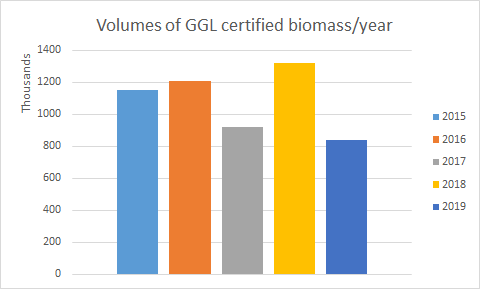
Just looking back to the last 5 years more than 5.4 million Metric Tons of biomass have been certified under the Green Gold Label and most of this biomass was used for energy production in The Netherlands, adding to the 115 PJ of renewable energy on an annual basis.
As it is possible to appreciate from the graph below, GGL starts to show a stable trend in terms of certified volumes of biomass from 2016 onwards. This was due to the combination of the growing importance of biomass as an alternative and renewable source of energy; and to the introduction of the Dutch subsidy, which is provided to enable and facilitate the transition toward renewable energy production (SDE+).
Source: GGL CB's
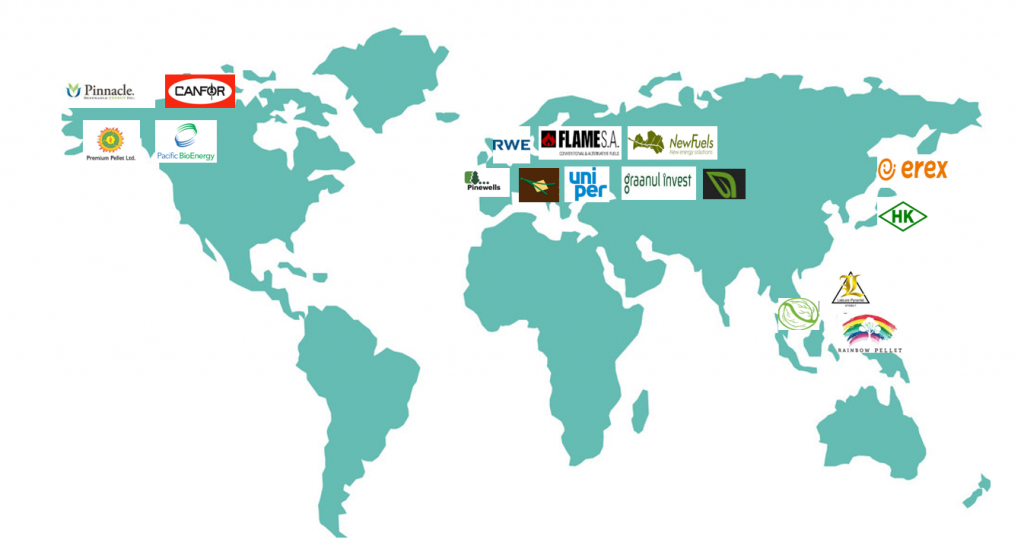
The GGL certificate is held by a very loyal group of 18 partners, amongst which Biomass Producers, Traders and Energy Producers.
These partners are based in 12 different countries around the world.
Source: GGL Certification Register dated May 2020
GGL as a guarantee Label
GGL wants to ensure that just residues are converted into biomass for energy use, with residues is meant both the result of forest management operations and also, agricultural residues (e.g. plant parts that do not have market value). This is done, by setting a number of strict requirements over sustainable management of forests and biomass sourcing, such as: That sourcing of biomass is done in a way that avoids resource depletion- only biomass coming from certified or verified sustainably managed Forest Units is accepted as GGL source; and just " residues" that cannot be used for other purposes can be turned into energy.
That illegal logging is avoided by requiring legal ownership of the forest by the forest manager as well as its compliance with all applicable National and International laws.
That the proper functioning of the forest is guaranteed in the long term, as forest management practices have to ensure biodiversity conservation and enrichment, water regulation, carbon sequestration, proper soil management; as well as, provisioning of alternative forest products (e.g., mushrooms, seeds, resins and herbs).
That along the supply chain the accounts for renewable biomass produced must match the amount processed both in volume and in sustainability requirements, guarantying that just the correct amount of certified biomass is recorded and traded. This is called the Mass Balance approach.
That the GHG emissions for production, processing and transport are calculated correctly with the Bio-Grace Tool II. Data are transferred from one link of the chain to the next one via Transaction Statements which are previously verified by an accredited Certification Body.
Furthermore, the rights of the workers and their health and safety are also central to the GGL standard. There are requirements in place about risk minimization in the working environment, such as: obligation to clean the air from dust and/or hazardous fumes; and obligation to provide training and to make sure that the workers make use of the personal protective equipment.
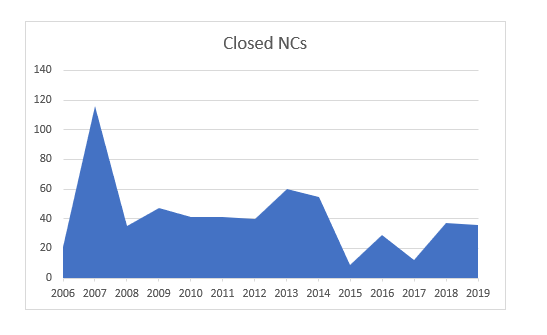
When biomass does not meet GGL requirements this is called a Non Conformity (NC). These NC's are recorded during the obligatory audits conducted by the Independent third parties (certification bodies or CBs). All the Non-Conformities found must be solved before the issuance of a GGL certificate. We see the number of NCs opened & closed over the years as further proof that GGL actively contributes to the increasing sustainability of biomass.
Source: GGL CB's
Finally, in 2019 GGL was approved by the Dutch Ministry of Economic Affairs and climate policy as fully compliant against the SDE+ subsidy scheme's requirements. Meaning that GGL can be used to show compliance against all the SDE+ requirements and for all the biomass categories.
Furthermore, at the same moment you are reading this post, GGL is developing new requirements to allow the use of Palm Kernel Shells (PKS), which results from the processing of palm oil nuts, into the production of clean energy! Thus facilitating the access of an otherwise considered waste material to become a new resource!
The Green Gold Label Foundation is very excited about these achievements as the data reveal a growing trend in sustainable sourcing and production of biomass which is opening new ways for truly renewable energy use in the long-term. As the number of Producers, Suppliers and Traders of renewable energy increases, our GGL Standard helps make sure that Consumers and Regulators can rely on this energy to come from sustainable sources; and to trust our Green Gold Label.